
The SonicWall 2026 Cyber Protect Report represents a fundamental shift in cybersecurity reporting. Rather than focusing solely on the volume of threats, it pivots towards ‘protection outcomes’, identifying why certain organisations remain resilient while others fall victim to breaches. For IT Directors, CIOs, and COOs in the legal and professional services sectors, the report’s central thesis is sobering: most breaches are not the result of exotic, highly sophisticated attacks, but rather predictable and preventable operational failures.
SonicWall categorises these failures into the ‘7 Deadly Sins of Cybersecurity’. Below is an analysis of these sins together with the strategic actions required to mitigate them.
1. Ignoring the Fundamentals
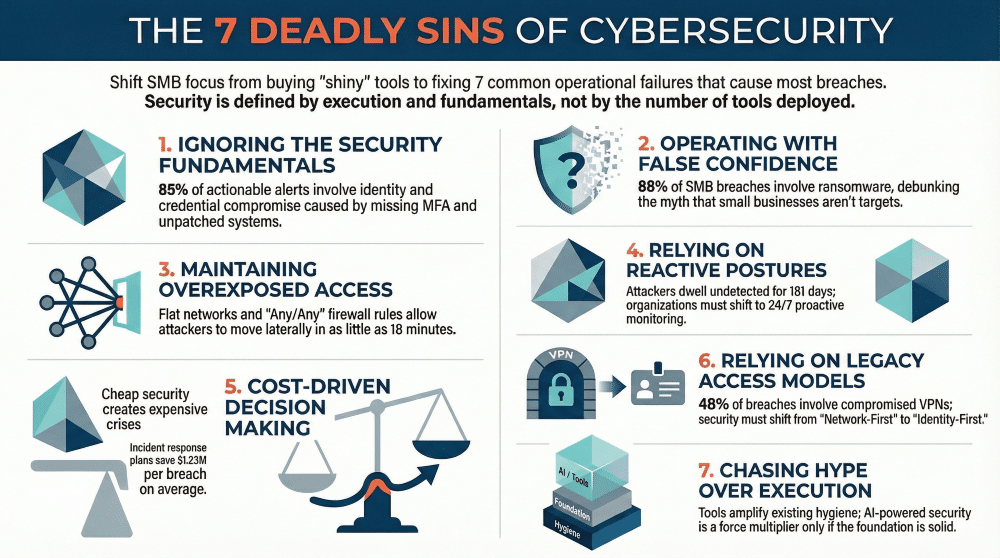
The report reveals that 85% of actionable security alerts now stem from identity, cloud, and credential compromise. The primary threat is no longer a complex ‘zero-day’ exploit but a stolen password. Fundamentals such as Multi-Factor Authentication (MFA), timely patching, and the principle of least privilege are often sidelined in favour of more ‘exciting’ projects.
Strategic Action: Transition from a project-based security mindset to a disciplined operational hygiene model. Enforce phishing-resistant MFA across all accounts and automate the patching of internet-facing systems to close the window of opportunity for automated bot scans, which currently occur at a rate of 36,000 per second.
2. False Confidence
A dangerous myth persists amongst mid-market firms that they are ‘too small’ to be a target. However, 88% of SMB breaches in 2025 involved ransomware—more than double the rate seen in large enterprises. Furthermore, there is a massive delta between perceived and actual resilience; 80% of leaders believe they can contain an incident in eight hours, yet industry data shows attackers dwell undetected for an average of 181 days.
Strategic Action: Validate security controls through regular, rigorous testing and third-party assessments. CIOs must replace assumptions with data-driven evidence of resilience, ensuring that incident response plans are not just documented but rehearsed.
3. Overexposed Access
Internal network structures in many professional services firms remain ‘flat’, relying on implicit trust once a user is authenticated. This overexposed access allows for rapid lateral movement. SonicWall observed cases where full network propagation occurred in just 18 minutes after the initial compromise.
Strategic Action: Adopt a Zero Trust Architecture (ZTA). Implement network segmentation to isolate critical client data and financial records, ensuring that a single compromised endpoint does not lead to a firm-wide catastrophe.
4. Reactive Security Posture
Many organisations operate without continuous monitoring, meaning they only respond once a breach has become visible—often far too late. With 44% of security alerts going uninvestigated due to ‘alert fatigue’, attackers are effectively given a free pass to operate within the network.
Strategic Action: Shift to a proactive posture by implementing 24/7 Managed Detection and Response (MDR). By utilising AI-driven monitoring and human-led threat hunting, firms can identify ‘living off the land’ techniques before they escalate into full-scale encryption events.
5. Cost-Driven Security Decisions
Deferring security investment due to short-term budget pressure is a ‘sin’ with high interest rates. The average cost of a single breach for a mid-market firm now exceeds £3.9 million ($4.91m) when factoring in downtime, recovery, and reputational damage.
Strategic Action: Reframe cybersecurity as a business value-driver and risk-mitigation tool rather than a pure cost centre. IT leadership must demonstrate the ROI of prevention, noting that organisations with an established incident response team save an average of £1 million per breach.
6. Reliance on Legacy Access Models
The report recorded an 82.5% growth in VPN vulnerabilities, with 60% rated as high or critical. Despite this, many firms still rely on traditional VPNs that grant broad network access once a user logs in, providing a perfect entry point for credential-harvesting attacks.
Strategic Action: Modernise remote access by replacing legacy VPNs with Software-Defined Perimeters (SDP) or Zero Trust Network Access (ZTNA) solutions. This ensures access is granted only to specific applications on a per-session basis, significantly reducing the attack surface.
7. Chasing Hype Over Execution
The final sin is the tendency to purchase ‘silver bullet’ technology—often AI-labelled—without fully deploying it or integrating it into existing workflows. Tools do not create outcomes; execution does.
Strategic Action: Prioritise the full optimisation of existing security stacks before investing in new technologies. Focus on the integration of tools into a unified management platform to reduce complexity and ensure that security policies are applied consistently across the entire estate.
Why Business Email Compromise Is the Threat Most Firms Are Not Ready For
The headline cyber threats, ransomware, data breaches, nation-state attacks, dominate vendor briefings and security budgets. The data on actual claims tells a different story.
According to Cysurance, a cyber insurance provider and SonicWall partner, 98% of cyber insurance claims stem from Business Email Compromise (BEC) and funds transfer fraud. BEC is a form of attack in which an attacker sends a convincing email impersonating a trusted contact to redirect a payment or obtain sensitive information. No malware. No stolen credentials. No technical exploit. Just a convincing email and a changed payment instruction.
For professional services firms that handle client payments, matter-related transactions, or supplier invoices, this is the attack pattern most likely to result in a financial loss. And the most effective control costs nothing: any change to payment details verified by voice, to a known number, before processing.
The Threat Landscape Is Getting More Precise
It would be wrong to suggest that the external threat is not intensifying. SonicWall’s data shows that high and medium severity intrusion attempts rose 20.8% year on year in 2025, even as total attack volume stayed broadly flat. Attackers are not attacking more. They are attacking better.
Automated scanning tools now generate over 36,000 vulnerability scans per second, according to SonicWall. These tools do not filter by company size or sector. If a system is exposed and unpatched, it is a target regardless of the organisation’s revenue or headcount.
The Log4j vulnerability, disclosed in 2021, was still targeted over 825 million times in 2025, according to SonicWall’s detection data. Four years after discovery, it remains an active attack vector because a significant number of organisations have still not patched it.
What a Security Posture Review Actually Covers
A security posture review is not a gap analysis against a compliance framework document. It is an honest assessment of whether the controls that are supposed to be working are actually working: whether MFA is enforced without exceptions, whether patch prioritisation reflects the speed of modern exploitation, whether access controls are actively maintained rather than assumed, and whether the incident response plan has ever been tested under realistic pressure.
For firms that have not conducted this kind of independent review recently, it is the right starting point.
Marlin Communications works with professional services firms to assess their security posture and address the gaps that create the most risk. Contact us to arrange a review.
Conclusion: A Roadmap for 2026
The comprehensive SonicWall Cyber Protect Report 2026 makes it clear that the gap between the protected and the exposed comes down to operational discipline. For professional services firms where client confidentiality is the cornerstone of the business, addressing these 7 sins is not merely an IT requirement—it is a strategic mandate.
At Marlin Communications, we specialise in helping IT leaders in the legal and financial sectors navigate these complexities. From implementing Zero Trust frameworks to providing 24/7 proactive monitoring, we ensure your infrastructure is optimised for resilience rather than just ‘compliance’. Whether you are looking to modernise your remote access models or require a comprehensive security audit to eliminate ‘false confidence’, our experts are here to align your technology with your strategic business goals.
To discuss how we can secure your firm against these 7 deadly sins, contact Marlin Communications today.
About Marlin Communications
Marlin Communications is committed to providing expert guidance on Zero Trust solutions.
Marlin Communications is an independent, single-source provider of business communications & collaboration solutions including voice, data, mobile, video, network security and contact centre technology for businesses of 50 – 5,000 staff.
We operate throughout the UK – with global reach – and our own, on-premises, 1,000 ft² Technology Suite at our Bath office, where we host regular events and showcase technology solutions for our clients. Contact us for your free comms audit or product demo.
Marlin Communications is ISO 27001 certified by BSI under certificate number IS795313.
Get the latest tech news & reviews – straight to your inbox
Sign up to receive exclusive business communications, tech content, new tech launches, tips, articles and more.
Click here to follow our LinkedIn company page and stay up-to-date with our LinkedIn newsletter