

Most firms in professional services have already moved their voice calls to the cloud. Teams, hosted telephony, SIP trunking. The handsets still work, the calls still connect, and the IT team has quietly ticked the box. Job done.
Except it isn’t. Not quite.
The Public Switched Telephone Network (PSTN) is being retired across the UK in January 2027. That deadline is close enough now that it should be a board-level operational priority rather than a mid-term IT roadmap item. But the migration most firms have completed only covers the obvious part: the phone calls that people make from desks and meeting rooms. What it almost never covers is the analogue infrastructure embedded in the building itself, the systems that nobody in the IT team manages, and that nobody outside of facilities has thought about in years.
That infrastructure is now a liability.
The compliance gap that nobody talks about
When a law firm or financial services business migrates its telephony, the conversation centres on voice quality, call recording obligations, and whether the new platform meets FCA or SRA requirements for business continuity. Those are all valid concerns. But business continuity isn’t just about whether your lawyers can make calls. It’s also about whether your building can function safely and legally when the analogue lines that support it stop working.
Fire alarms, lift emergency phones, access control systems, and intruder alarm panels are not IT infrastructure. They sit outside the typical technology remit. They’re procured through facilities teams, maintained by contractors, and invoiced separately from the main comms estate. Which is precisely why they get left out of migration planning.
The SRA expects firms to have robust business continuity arrangements in place. The FCA holds regulated firms to similar standards. Neither regulator specifies telephony architecture, but both expect firms to identify and manage operational risks. A lift emergency phone that goes silent during an incident, or a fire alarm panel that can no longer reach its monitoring centre, is exactly the kind of operational failure those obligations are designed to prevent.
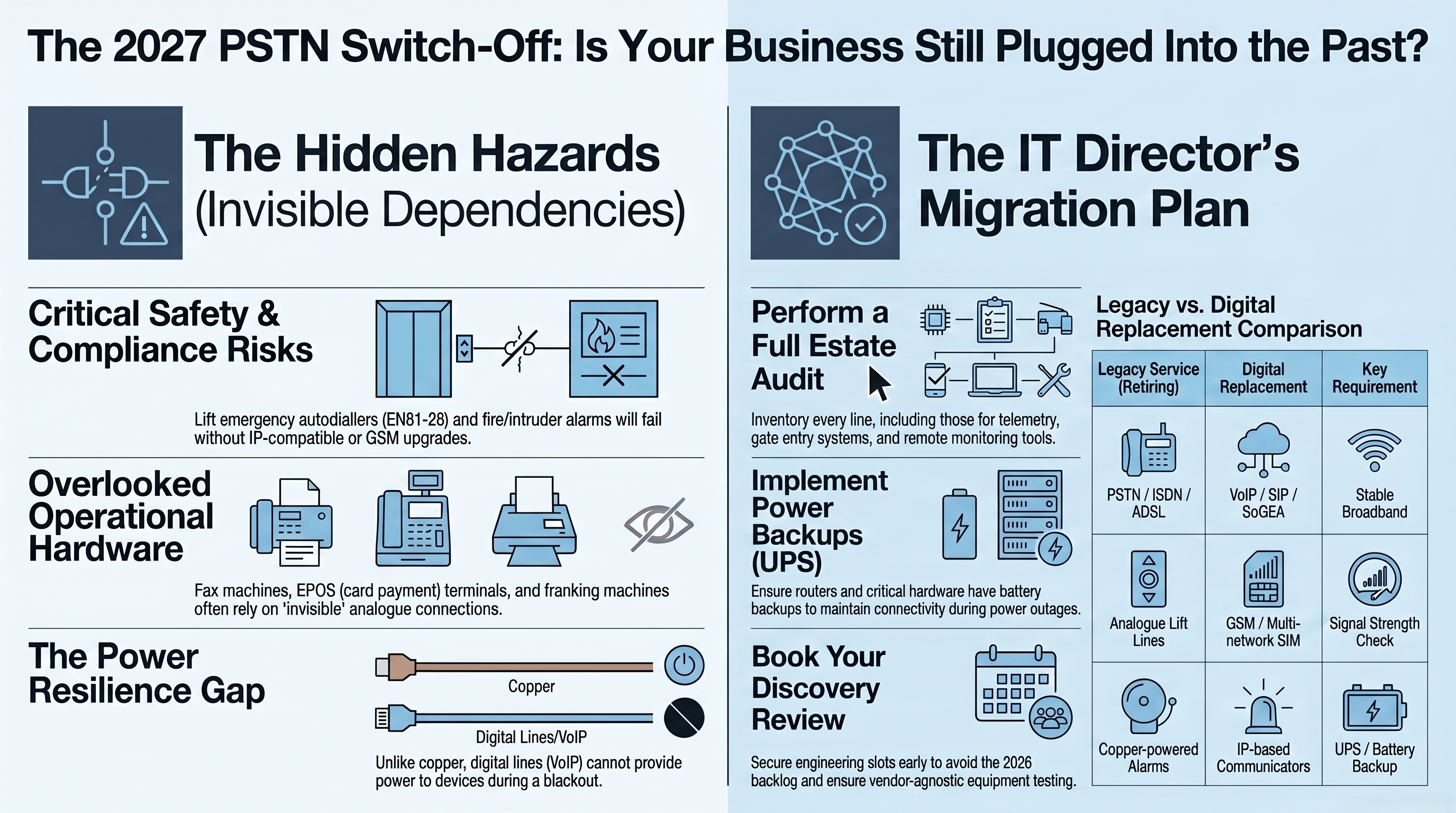
Critical infrastructure: what’s actually at risk
Lifts: a specific legal obligation
EN81-28 is the British Standard that governs rescue systems for lifts. It requires a two-way communication link between the lift car and an alarm receiving centre, available 24 hours a day, seven days a week. Most lifts installed or upgraded before 2020 achieve this via an analogue autodialler connected to a copper phone line.
The problem is straightforward: analogue autodiallers rely on a dial tone from the PSTN. When the PSTN goes away, they stop working. The lift can still move, but the emergency communication system fails. That’s a breach of EN81-28. Depending on the terms of your building lease or your employer liability obligations, it may also create a more immediate legal exposure.
The fix is to replace the autodialler with a GSM or IP-based unit that operates independently of the copper network. This is not a complicated job, but it requires someone to identify which lifts are affected, commission the right equipment, and arrange the swap before January 2027.
Alarms: the insurance problem
Most commercial premises use a Dualcom or similar dual-path signalling system to connect their intruder and fire alarm panels to an Alarm Receiving Centre. Historically, one of those paths has been PSTN. When the copper line goes, that path goes with it.
Some systems will fail gracefully and continue transmitting via an alternative path, typically GPRS or GSM. Many will not. The alarm panel will still sound locally, but the signal to the monitoring centre will be lost. The building looks protected from the outside. It isn’t.
The insurance dimension is serious. Most commercial property policies require premises to maintain a monitored alarm system that meets specific grades under BS EN 50131. If your alarm system loses its signalling path and that loss goes undetected, your coverage may be invalid at the point of a claim.
Building access: the quiet risk
Gate entry systems and door intercoms are easy to overlook. They tend to work without much intervention for years, they don’t have a user base that complains, and they sit at the edge of the building rather than in any server room or comms cabinet. But a significant number of them still communicate over PSTN, particularly in buildings where the access control system was installed more than ten years ago.
A gate intercom that loses its connection doesn’t just fail to ring. Depending on how the system is configured, it may default to locked (locking people out) or to open (leaving the site unsecured). Neither outcome is acceptable for a law firm managing confidential files, or a financial services office handling client data under GDPR.
Stop Sell: the deadline is already here
January 2027 is when Openreach will complete the PSTN switch-off nationally. But Stop Sell restrictions have already rolled out across much of the UK exchange network. That means:
- New PSTN lines can no longer be provisioned in many areas
- Existing faults may not be repaired if a copper circuit needs replacing rather than patching
- PDQ payment terminals, utility telemetry sensors, and any remaining fax infrastructure cannot simply be replaced with like-for-like equipment
In practice, this means the transition is not something firms can defer until 2026. It is happening now, at the exchange level.
A four-step action plan for CIOs and COOs
- Audit the full line estate. Not just the lines managed by IT, but every analogue circuit in the building. Lift emergency phones, alarm communicators, gate entry systems, PDQ terminals, environmental sensors. Everything.
- Categorise by risk. Lifts and alarms have specific legal obligations attached. Access control and payment infrastructure have operational and compliance implications. Prioritise accordingly.
- Test before you transition. Swapping to a GSM or IP communicator doesn’t guarantee it works as expected. Test signal paths, confirm monitoring centre connectivity, and document the results.
- Set a hard deadline of Q3 2026 for completion. That leaves a buffer before the national switch-off and time to address anything that doesn’t go smoothly on the first attempt.
Marlin Communications Can Help
This is manageable. It just needs to be managed deliberately, by someone who understands both the regulatory obligations and the technical options. Marlin Communications can audit your line estate and replace legacy connections with digital or cellular alternatives across lift, alarm, and access control. Get in touch to talk through your migration plan.
About Marlin Communications
Marlin Communications is committed to providing expert guidance on Zero Trust solutions.
Marlin Communications is an independent, single-source provider of business communications & collaboration solutions including voice, data, mobile, video, network security and contact centre technology for businesses of 50 – 5,000 staff.
We operate throughout the UK – with global reach – and our own, on-premises, 1,000 ft² Technology Suite at our Bath office, where we host regular events and showcase technology solutions for our clients. Contact us for your free comms audit or product demo.
Marlin Communications is ISO 27001 certified by BSI under certificate number IS795313.
Get the latest tech news & reviews – straight to your inbox
Sign up to receive exclusive business communications, tech content, new tech launches, tips, articles and more.
Click here to follow our LinkedIn company page and stay up-to-date with our LinkedIn newsletter