
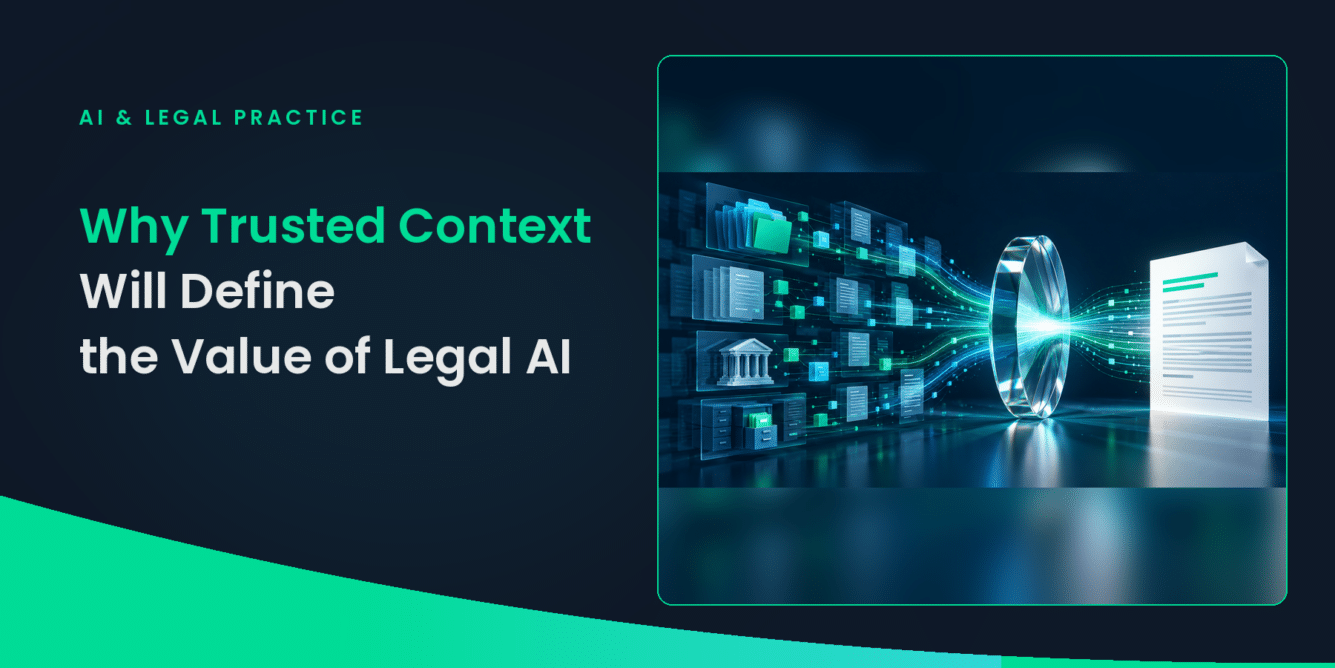
Legal expertise has never been built on information alone.
This is the second in our three-part series on AI and legal practice. The first article looked at why Shadow AI is spreading inside law firms and what governed adoption looks like in practice. The third examines why organisational knowledge is becoming the next competitive advantage for law firms.
It’s built on context. Trusted context.
Every client conversation. Every matter. Every negotiation. Every precedent. Together they shape the judgement that allows lawyers to advise with confidence. The law may be public, but great legal advice is built on understanding the circumstances surrounding it.
For generations, lawyers have accumulated that context through experience. It lives in documents, emails, meeting notes, conversations, matter files and, perhaps most importantly, in expert minds.
The challenge has never been creating knowledge.
It’s been finding the right knowledge at the right moment.
That’s why the conversation around AI within the legal profession is beginning to change.
For the past two years, much of the debate has focused on what AI can do. Draft a document. Summarise a case. Analyse a contract. Those capabilities matter, but they only tell part of the story. The real opportunity lies elsewhere.
The value of AI in legal won’t be determined solely by the sophistication of the model. It will increasingly be determined by the quality of the context it can securely access.
Legal work depends on accuracy, judgement and a deep understanding of the client, the matter and the firm’s own experience. AI becomes significantly more valuable when it can operate within that trusted context, helping lawyers work more efficiently while maintaining the professional standards clients expect.

The false choice between security and convenience
Security and convenience are often presented as competing priorities.
The assumption is familiar. The more secure a system becomes, the harder it is to use. The easier something is to access, the greater the risk.
For law firms, where confidentiality is fundamental to client trust, it’s understandable why security has dominated the conversation. But framing security and convenience as opposing forces risks missing a much bigger opportunity. If lawyers can’t easily access trusted AI through approved channels, they’ll naturally look elsewhere.
We explored this in our previous article through the rise of Shadow AI. The takeaway wasn’t simply that lawyers are using AI outside firm governance. It was that they’re looking for tools that help them work more effectively.
The answer isn’t to create more friction. It’s to remove it safely. The firms leading AI adoption aren’t asking lawyers to choose between productivity and security. They’re designing environments where the two reinforce each other.
Context is becoming the differentiator
Ask any experienced lawyer what makes someone effective, and they’re unlikely to talk about how quickly they can produce a first draft. They’ll talk about understanding the client, remembering why a particular approach was taken three years ago, knowing which precedent achieved the right commercial outcome, or recognising the risks that never appear in the documents.
That’s context.
And it’s becoming one of the most valuable assets any law firm possesses.
Without that context, AI can generate competent language. With it, AI has the potential to help lawyers build on the collective experience of the firm, drawing on knowledge, experience and institutional memory rather than starting from scratch each time.
That’s a very different proposition. One that, if nurtured effectively, has the potential to become a genuine competitive advantage as firms learn to harness one of their most valuable assets: their collective knowledge and context.
The Law Society recently explored the growing role of AI in legal research, emphasising that firms must assess both the opportunities and the risks of these technologies. The message wasn’t simply about adopting AI responsibly. It recognised that the quality and reliability of AI outputs depend on how lawyers evaluate, verify and apply them within the context of legal practice.
That’s an important distinction.
AI is most valuable when it strengthens judgement rather than substitutes for it.
Security enables better legal work
Perhaps it’s time to redefine what security means in the age of legal AI.
For years, the conversation has centred on protecting information, and rightly so. Confidentiality remains fundamental to legal practice. But as AI becomes more deeply embedded in the way lawyers work, security takes on another role. It protects the context that gives information its value.
That context extends far beyond documents. It includes client knowledge, institutional memory, commercial understanding and the collective experience that lawyers build over years of advising clients. It’s also what allows firms to deliver consistent judgement rather than simply consistent outputs.
When AI can securely access that context, its role changes. Rather than simply generating content, it helps lawyers surface the knowledge, reasoning and experience that already exists across the firm.
The benefits are felt long before a document is drafted. Lawyers spend less time searching for information they’ve already seen. Teams avoid recreating work that already exists. Knowledge flows more naturally across practice areas, offices and generations of lawyers, allowing every new matter to benefit from the experience of those that came before it.
Recent research from The Lawyer found that AI has moved rapidly from experimentation to expectation across many firms. As adoption accelerates, the conversation is increasingly shifting away from whether AI should be used and towards how it can be embedded securely into everyday legal work.
That shift feels significant.
Because firms that treat security as the foundation for trusted AI aren’t simply reducing risk. They’re creating the conditions for lawyers to work with greater confidence, stronger context and better access to the collective expertise of the firm.

The strategic opportunity
The conversation about legal AI has often been framed as a balance between convenience and security. In reality, the most forward-looking firms are beginning to see them differently. The firms making the greatest progress don’t see security as a barrier to AI adoption. They see it as the foundation that makes meaningful adoption possible.
And once trusted AI can securely connect lawyers with the right context, information and organisational knowledge, the conversation moves beyond productivity altogether. It becomes about something much more enduring.
How does a firm ensure that every lawyer can build on the collective experience of everyone who came before them?
That’s no longer just a knowledge management question. It’s becoming one of the defining strategic questions facing modern law firms. Because in an era where AI models are becoming increasingly capable, the firms that stand apart won’t simply have better technology. They’ll have built a better foundation for that technology to learn from.
Sources
- Law Society of England and Wales – Conducting legal research in the age of AI (25 June 2026): https://www.lawsociety.org.uk/topics/ai-and-lawtech/conducting-legal-research-in-the-age-of-ai
- The Lawyer – Embedding AI: Leadership, Culture and Capability in Law Firms (April 2026 research report): https://media.thelawyer.com/uploads/2026/04/Legora-The-Lawyer-Embedding-AI.pdf
About Marlin Communications
Marlin Communications is an independent, single-source provider of business communications & collaboration solutions including voice, data, mobile, video, network security and contact centre technology for mid-market professional services businesses.
We operate throughout the UK – with global reach. Contact us for your free comms audit or product demo.
Marlin Communications is ISO 27001 certified by BSI under certificate number IS795313.
What are your communications priorities?
Try our traffic light system to map your comms priorities.