
Updated 21 August 2026: this post (originally published Jan 2026) has been refreshed to include findings from SonicWall’s 2026 Professional Services Protect Brief, released August 2026, which recorded the sector’s largest attack volume of any vertical SonicWall tracks and 332 million scanning attempts against SIP-based phone systems specifically.
TL;DR: For IT leadership in legal, finance and professional services, the traditional “moat and castle” security model no longer holds up against how attackers are actually getting in. Zero Trust Network Access (ZTNA) replaces implicit network trust with identity-based, application-specific access, closing the exact lateral movement risk SonicWall’s 2026 sector data shows attackers are exploiting most. Implementing zero trust network access is now a documented response to a measured threat, not a theoretical upgrade.
Professional services firms generated more attack traffic in the first half of 2026 than any other sector SonicWall tracks: 3 billion intrusion prevention events, 69.9 million ransomware hits, and 332 million scanning attempts against SIP-based phone systems, a scale unique to this sector. The common thread across nearly all of that activity is a network built on implicit trust, where one compromised credential opens the door to everything behind it. ZTNA is the architecture built to close that door.
The Erosion of the Corporate Perimeter
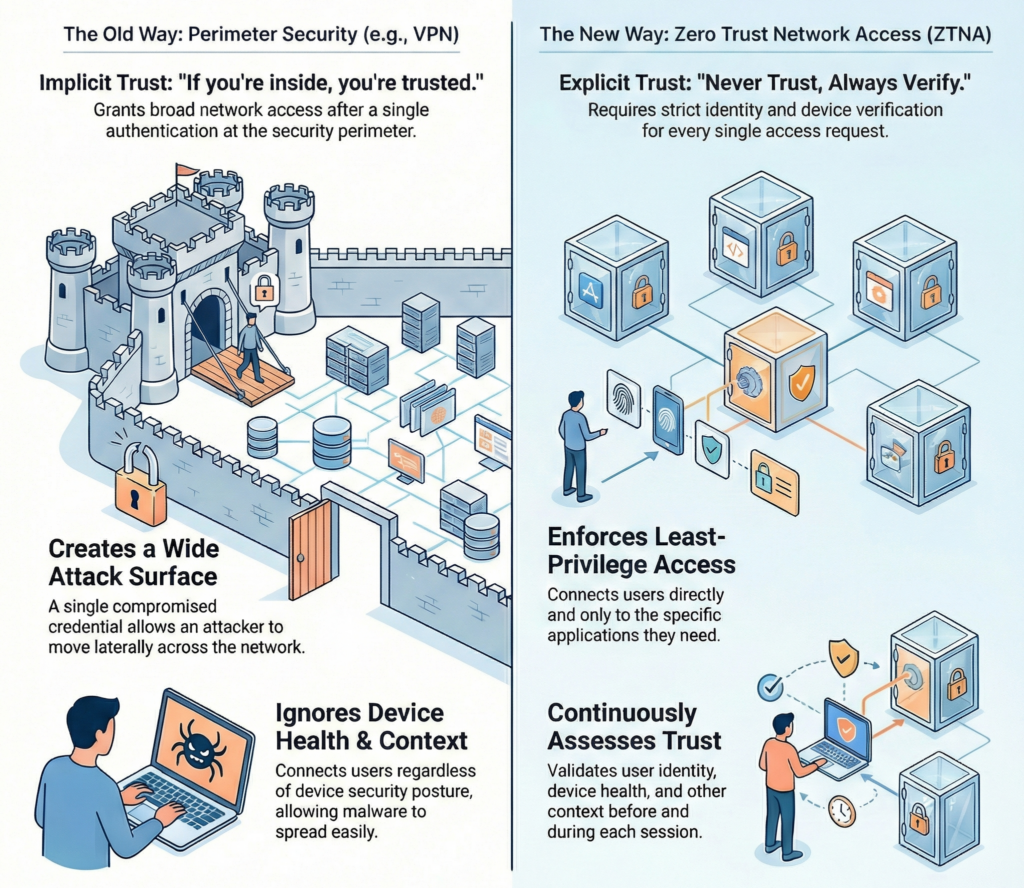
For decades, cybersecurity was built on a simple premise: trust everything inside the network and distrust everything outside. For modern professional services firms, that perimeter has effectively dissolved. Hybrid working, SaaS platforms like Microsoft 365, and increasingly targeted threats mean the “internal” network is no longer a safe zone.
Legacy Remote Access VPNs compound the problem. They typically grant a user broad access to the entire network once they clear the initial login, a flat structure where one compromised credential lets an attacker move laterally to client case files, financial data, or, as SonicWall’s 2026 data on professional services shows, the phone system itself.
Defining Zero Trust Network Access (ZTNA)
Zero Trust Network Access is a security framework built on “never trust, always verify.” Unlike a VPN, which connects a user to a network, ZTNA connects a verified user to a specific application or resource. Access is never granted implicitly on the basis of physical location or IP address.
To work in practice, ZTNA relies on three core components:
- Identity-based authentication: access is granted on the identity of the user and the device, typically requiring Multi-Factor Authentication (MFA) to confirm the person requesting access is who they claim to be.
- The Principle of Least Privilege (PoLP): users see only the applications required for their role. A legal secretary, for example, has no visibility of the firm’s core financial servers.
- Continuous verification: trust is not a one-time event. ZTNA monitors device health and location throughout the session, revoking access immediately if risk is detected.
Why ZTNA Is Critical for UK Professional Services
For CIOs and IT Directors in regulated industries, ZTNA is a strategic response to risk and governance requirements, not just a technical upgrade.
Enhancing Legal Confidentiality and SRA Compliance
Law firms handle vast volumes of privileged information. ZTNA’s micro-segmentation isolates sensitive case files, and connecting users directly to applications reduces the attack surface while producing the granular audit logs Solicitors Regulation Authority (SRA) standards expect.
Securing Finance and Accountancy Data
In finance, the threat of lateral movement is particularly acute. ZTNA protects against both external breaches and insider threats by treating every access request as potentially hostile, aligning with FCA and PRA requirements for resilient infrastructure and data integrity.
Closing the VoIP and SIP Gap
SonicWall’s 2026 Professional Services Protect Brief recorded 332 million SIPVicious hits against SIP-based phone systems in the sector in the first half of the year alone, a signature that appears at this scale in no other vertical SonicWall tracks. The risk is structural: professional services firms run distributed phone infrastructure with SIP endpoints reachable from outside the network, and where that infrastructure shares a network with client portals or document management platforms, a compromised SIP credential becomes a route into far more than the phone system.
This is precisely the exposure ZTNA is designed to close. Because access is scoped to a specific application rather than the network as a whole, a compromised phone system credential stops being a route to everything else on the estate. We’ve covered the full data behind this, including the ransomware breakdown, in a separate piece on VoIP security for professional services firms.
Optimising the Hybrid Work Experience
Modern ZTNA solutions, such as SonicWall’s Cloud Secure Edge (CSE) or Fortinet’s ZTNA framework, are built to feel seamless for employees. Because the connection is application-specific rather than network-wide, users often see faster connectivity and lower latency than with a traditional VPN.
Implementing a Zero Trust Roadmap
Transitioning to a Zero Trust Architecture is a journey, not a single deployment. SonicWall puts the underlying risk plainly: 61% of breaches start with a stolen credential, and a traditional SSL VPN turns that single credential into a master key to the network. Closing that gap requires a partner who understands the intersection of security, connectivity, and sector-specific compliance.
At Marlin Communications, we act as a strategic extension of your internal IT team. As an ISO 27001-certified business and a Microsoft Partner, we curate best-of-breed ZTNA solutions from industry leaders including Fortinet and SonicWall, matched to your existing infrastructure and compliance requirements rather than a rip-and-replace project.
Is Your Current Remote Access Strategy Creating a Security Bottleneck?
Compliance and data security are non-negotiable for UK professional services, and the data now shows exactly where attackers are looking first. Marlin Communications provides the technical expertise and strategic framework to modernise your network, including your voice infrastructure. Book a discovery session with our UK experts to start your transition to Zero Trust.
About Marlin Communications
Marlin Communications is committed to providing expert guidance on Zero Trust solutions.
Marlin Communications is an independent, single-source provider of business communications & collaboration solutions including voice, data, mobile, video, network security and contact centre technology for businesses of 50 – 5,000 staff.
We operate throughout the UK – with global reach – and our own, on-premises, 1,000 ft² Technology Suite at our Bath office, where we host regular events and showcase technology solutions for our clients. Contact us for your free comms audit or product demo.
Marlin Communications is ISO 27001 certified by BSI under certificate number IS795313.
Get the latest tech news & reviews – straight to your inbox
Sign up to receive exclusive business communications, tech content, new tech launches, tips, articles and more.
Click here to follow our LinkedIn company page and stay up-to-date with our LinkedIn newsletter